
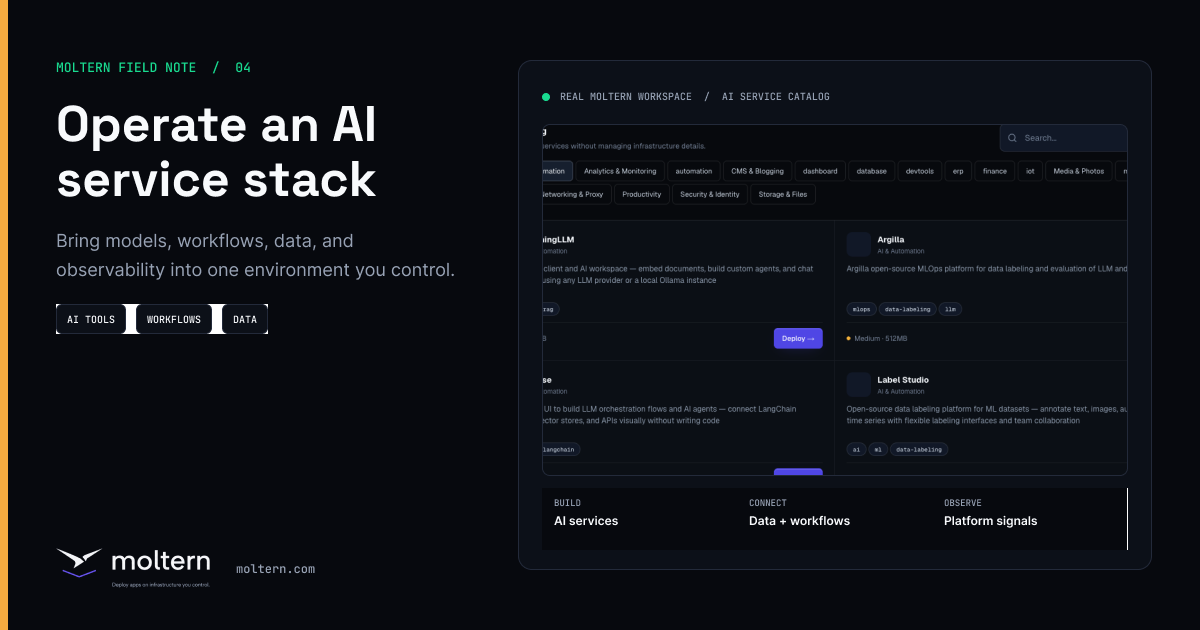
AI projects often start as one tool and quickly become a stack. A private chat UI needs a model provider or runtime. Retrieval needs a vector database. Agents need a workflow builder. Teams also need observability, cost controls, data boundaries, and a place to understand what is running.
Moltern is useful for AI service stacks because it lets teams group AI tools, databases, gateways, and supporting apps in an environment instead of scattering them across separate infrastructure steps.
Common AI stack patterns
| Goal | Typical services | What to watch |
|---|---|---|
| Private team chat | Open WebUI, LibreChat, LobeChat, Ollama, LiteLLM | Authentication, model provider keys, storage, and public route exposure. |
| Visual agent workflows | Flowise, Langflow, LiteLLM, Qdrant, Chroma, Weaviate | Prompt data, vector database ownership, API keys, and traceability. |
| Model gateway | LiteLLM or another gateway service | Rate limits, provider credentials, usage, and who can call the endpoint. |
| Prompt observability | Langfuse, Argilla, logging and analytics services | Retention, privacy, data sampling, and environment boundaries. |
| Document retrieval | Chat UI, embedding provider, vector database, document processing service | Data approval, storage growth, access control, and retrieval quality. |
Why Moltern helps AI teams
AI tools are infrastructure-heavy even when the first demo looks simple. A team may deploy Open WebUI for a private chat interface, LiteLLM for a central model gateway, Flowise for agent workflows, Langfuse for prompt observability, and Qdrant or Chroma for retrieval. Each service has a different owner, data risk, resource shape, and exposure policy.
Moltern gives those services a shared workspace model. Users can place them in an environment, review service status, keep variables out of source code, attach domains only when needed, and inspect usage before a test stack becomes production.
A safer first AI stack
- Create an `ai` or `staging` environment.
- Deploy a chat UI or workflow builder from the service catalog.
- Deploy a model gateway or connect an external provider.
- Add a vector database only when retrieval is required.
- Keep the route private until authentication is configured.
- Use non-sensitive sample data for the first retrieval tests.
- Review logs, resource usage, and service ownership before inviting the wider team.
Cost and data boundaries
AI stacks can grow quickly because they combine compute, storage, and external model provider spend. Before production use, review Moltern plan limits, external provider budgets, vector database storage growth, and public route exposure. AI services are useful, but they should not become invisible infrastructure.
The Moltern AI services guide is the right next step when planning a chat, agent, model gateway, observability, or retrieval stack.