
Teams usually start looking for a deployment platform because the simple path has become too manual. A repository needs a build. The app needs a domain. A database has to be created. Someone has to keep logs, environment variables, secrets, usage, and failure recovery understandable for the rest of the team.
Heroku, Vercel, Netlify, Coolify, and Moltern all help with parts of that problem, but they optimize for different operating models. Heroku is a long-running platform-as-a-service. Vercel and Netlify are strong frontend and web delivery platforms. Coolify is a self-hostable deployment platform. Moltern is built for teams that want Git-backed app deployment and a large service catalog inside a workspace they can operate from one console.
The short version
Choose the product that matches the job you are trying to simplify. If you only need a static site or frontend app, a frontend cloud can be the fastest path. If you want a classic managed PaaS, Heroku remains familiar. If you want to self-host a deployment platform, Coolify is a strong reference point. If you want Git deployments, catalog services, environments, domains, logs, and usage visibility in one self-hosted control plane, Moltern is built around that combined workflow.
| Platform | Best known for | Where Moltern is different |
|---|---|---|
| Heroku | Managed app deployment and add-on style platform workflows. | Moltern focuses on self-hosted operation, workspace environments, and an integrated service catalog on infrastructure you control. |
| Vercel | Frontend, serverless, edge, and framework-centric web delivery. | Moltern is broader for teams that also need databases, internal tools, AI services, environments, and operational visibility. |
| Netlify | Static sites, Jamstack workflows, deploy previews, and frontend delivery. | Moltern is designed for app plus service operations, not only site deployment. |
| Coolify | Self-hosted deployment workflows and infrastructure control. | Moltern emphasizes a workspace model with service catalog docs, environment grouping, usage guardrails, and app/service visibility. |
What comparison pages often miss
Most deployment comparisons focus on the build step. That matters, but it is not the only operational cost. Production teams also need service ownership, custom domains, environment separation, secrets, logs, billing usage, storage decisions, and a way to understand which workloads are healthy.
The official docs for Heroku Git deployments, Vercel, Netlify, and Coolify show how each platform frames its strengths. Moltern's view is that app deployment and supporting services should be managed together because real products rarely run as code alone.
Where Moltern is strongest
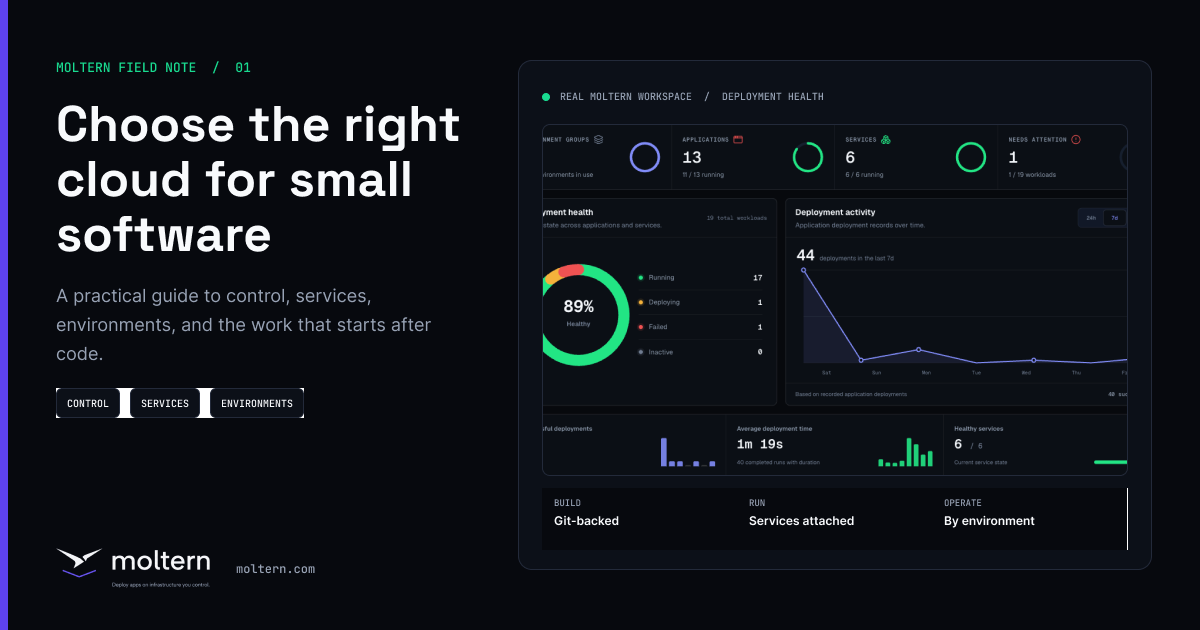
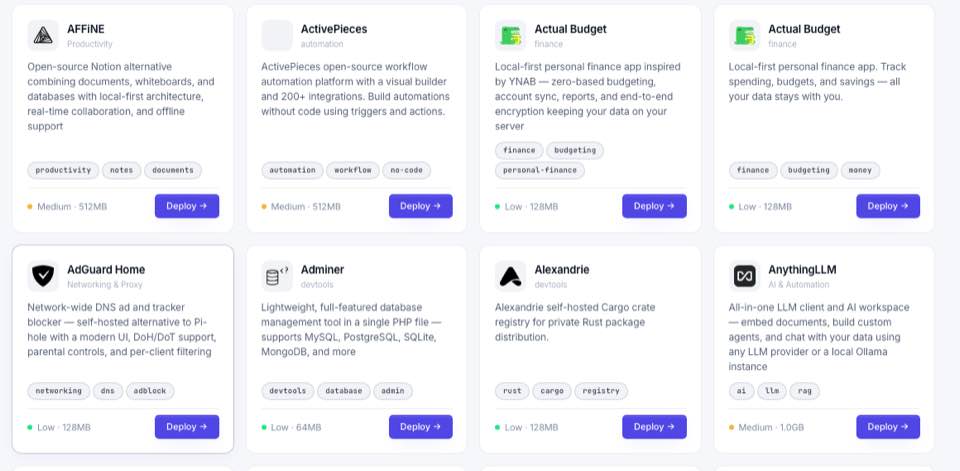
Moltern is strongest for teams that want one workspace for applications and services. A backend can be deployed from Git. A PostgreSQL database, Redis cache, monitoring dashboard, CMS, automation service, or AI tool can be launched from the catalog. Environments keep production, staging, and internal tools organized. The dashboard keeps status, recent work, and follow-up actions visible.
That makes Moltern especially useful when the team wants self-hosting without asking every developer to become a Kubernetes operator. The platform hides the repetitive infrastructure wiring while still preserving control over where workloads run.
Decision checklist
- Do you need only a frontend site, or do you need app plus services?
- Do you want a managed platform, or do you need infrastructure control?
- Will your team run databases, queues, AI tools, automation, CMS, and dashboards beside apps?
- Do non-operators need a safe way to deploy and inspect workloads?
- Do you need environment grouping, billing usage, and service docs in the same product?
If most answers point to app plus service operations on infrastructure you control, Moltern is the platform to evaluate.